
A Look Back at 40 Years of Production in Heinsberg
27. October 2026 | Blog
When the first carbon fiber production line went into operation in Heinsberg-Oberbruch in 1986, the site was still operated by Enka. The capacity at that time, 360 metric tons per year, has since expanded to 5,100 metric tons. Much has changed in other respects as well. A chronicle.
Anyone entering the production site in Heinsberg-Oberbruch today will find four production lines. Carbon fibers, thermoplastic semi-finished products, and dry reinforcement textiles are produced here.
Yet the history of production in Oberbruch began with a different material: in 1950, Germany’s first large-scale synthetic fiber plant for Perlon was established here. Thirty-five years later, Oberbruch was Europe’s largest and most efficient manufacturing facility for polyester filament yarn. So how did carbon fiber come to Oberbruch?
From Bamberg via Japan to Oberbruch
The Wuppertal-based company Enka-Glanzstoff had already been working with fiber-reinforced plastics in the early 1970s. At that time, it was integrated into the Dutch chemical company Akzo; four years later, it expanded into aramid. An employee first encountered the topic of carbon fibers in 1977 at a VDI conference in Bamberg. Quickly convinced of its technical potential, the company began formulating its first strategic considerations regarding carbon fibers as early as the following year.
Karlheinz Hillermeier, former head of development at Teijin Carbon Europe, recalls: “I was quickly convinced of the benefits of carbon fiber, because we had already demonstrated the weaknesses of aramid in terms of compressive strength in composite materials.”
The next steps followed in rapid succession: In January 1979, the strategic considerations were forwarded to the Akzo Executive Board, and the first trip to Japan took place in late April 1980. The collaboration finally began in 1982. When it came to deciding on a location, Oberbruch prevailed over Obernburg and a plant in the Netherlands.
Tenax Marks the Beginning of a New Chapter in Heinsberg
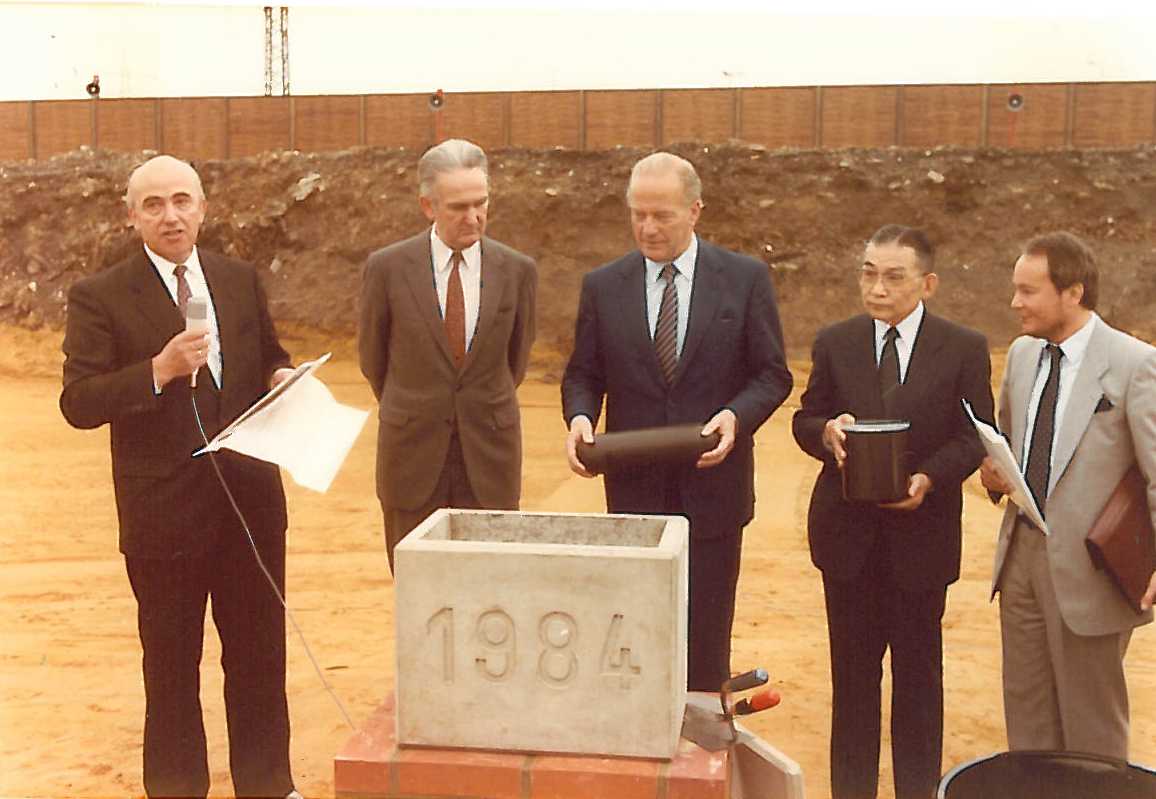
As part of this collaboration with Toho Rayon, Enka began distributing the Japanese carbon fiber “Besfight” in Europe in 1983. Drawing on Toho Rayon’s expertise, plans were made to establish Enka’s own carbon fiber production facility in Germany. The relevant contracts were signed in March 1983, and the cornerstone was laid in 1984. After two years of construction, the plant began operations in 1986 with an initial annual capacity of 360 metric tons, and the first 60 production employees began their work in Oberbruch. The launch of production coincided with the introduction of the TENAX brand, under which the carbon fibers manufactured in Oberbruch were marketed.
Friedrich Karl Nau, then plant manager at Enka Oberbruch, emphasized even back then the innovative spirit that still defines the company today: “If the economic strength of a production facility and job security are to be maintained, technological innovations are constantly necessary. Today, we stand at a significant turning point in our plant’s history. With the carbon fiber facility that has just been completed, the Oberbruch plant is gaining a modern production division that will effectively complement the traditional synthetic fibers manufactured here and is intended to open up new markets in technical applications.”
Every Beginning Is Difficult
Technically, the company was well-positioned with more than 50 certifications, particularly in the aerospace sector. Economically, however, the business initially developed more slowly than expected, as the market for carbon fibers grew only modestly. Added to this was rising price pressure resulting from cuts in aircraft programs, declining demand, and overcapacity. To remain in business, a global presence was increasingly seen as necessary.
Consequently, on January 1, 1993, Tenax’s operations were transferred to the newly founded Tenax Fibers GmbH & Co. KG. Toho initially acquired 51 percent of the shares, while Akzo held 49 percent. At first, little changed for the plant employees at the site: carbon fibers continued to be produced in Oberbruch under the TENAX brand. The goal was to secure and expand the company’s market position in Europe, both in the aerospace industry and in other application areas.
With the commissioning of the second production line in 1998, capacity in Oberbruch rose to approximately 1,800 metric tons per year. Additional production facilities followed in 2006 and 2009, increasing total capacity to 5,100 metric tons per year.
Heinsberg Today: 40 Years of Innovation and Looking Ahead
Today, approximately 400 employees work at the plant, in departments ranging from engineering and quality management to accounting and logistics. In addition to carbon fibers, the plant also produces reinforcing textiles and thermoplastic semi-finished products. There are also two development lines.
What began in 1986 as a new production division is now a growing facility that stands for material innovations and decades of German-Japanese cooperation. This ties in perfectly with the idea that Friedrich Karl Nau articulated at the plant’s opening: Technological innovations remain the most important prerequisites for shaping the future.
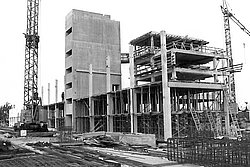
Historic black-and-white photograph showing the construction of the first carbon fiber production line in Heinsberg-Oberbruch in 1984.