
To preserve or to replace? How carbon-reinforced concrete can transform bridge rehabilitation
11. August 2026 | Blog
Demolishing and replacing an aging bridge is not always the most economical solution. Carbon-reinforced concrete can help engineers strengthen existing structures, reduce material consumption, shorten construction periods and extend their service life. The Oder Bridge in Küstrin-Kietz is one example of the measurable impact carbon fibers can have on modern infrastructure.
Across Europe, aging postwar infrastructure faces increasing pressure, with many bridges approaching the end of their planned service life. Modern bridges are generally designed for long service lives, but many older bridges were built under different technical standards and now face increasing maintenance needs. One of the central challenges is the corrosion of conventional steel reinforcement, which can damage both the reinforcement and the surrounding concrete. Thus, over time bridges eventually require extensive rehabilitation or replacement.
Rehabilitation work, closures or replacement projects of important structures can disrupt traffic, local communities and economic activity for months or even several years. As replacement constructions require significant amounts of concrete and steel and involve long construction periods that generate substantial CO2-emissions, completely replacing an aging bridge is not always the most sustainable or economical option. In many cases, strengthening and preserving existing structures can offer economic, environmental and operational advantages.
This question was also at the center of a recent exchange with Ute Bonde, Berlin’s senator for mobility, transport, climate protection and environment.
Our colleagues, Sabrina Beverungen and Hinrich Hampe, discussed with her whether aging bridges always need to be replaced, or if intelligent strengthening solutions could extend the lifespan of existing structures. The conversation revealed that infrastructure modernization presents engineering, economic, environmental, and political challenges.
Why conventional reinforced concrete reaches its limits
Conventional reinforced concrete relies on reinforcement with steel that needs a thick layer of concrete to protect it. Although modern infrastructure has relied on this method for decades, steel remains vulnerable to corrosion when moisture, chlorides or other aggressive substances penetrate the concrete cover. As a consequence, bridges built with steel reinforced concrete have a higher structural weight, greater material consumption and need recurring maintenance, which further increases the lifecycle costs. Over time, corrosion can lead to cracking, spalling, recurring repairs and rising lifecycle costs. The greatest challenge is that deterioration may develop inside the structure, not visible to the naked eye for years.
What is carbon concrete?
Due to its high strength and flexibility, carbon fiber can be used in a wide range of construction applications including the refurbishing of existing structures and the reinforcement of new structures. Carbon-reinforced concrete is a composite material that consists of concrete and a non-metallic reinforcement made from carbon fibers. Depending on the applications, the reinforcement can take the form of grids, mats, textiles or reinforcing bars. Its high textile strength, low weight and resistance to corrosion make it suitable for both new construction and the strengthening of existing concrete structures. In rehabilitation projects, carbon grids can be embedded in thin layers of fine-grained concrete applied to the existing structure, increasing load-bearing capacity while adding comparatively little thickness and weight.
How does carbon reinforcement help?
To put it simply: unlike steel reinforcement, carbon reinforcement does not corrode. It therefore requires significantly less protective concrete to cover structures, enabling thinner and lighter structural components and reducing concrete consumption. The key material properties of carbon concrete include its tensile strength, low weight, long-term durability and chemical resistance. Depending on the construction method, the low weight and reduced component thickness can also simplify transport, handling and installation. Beyond bridges, carbon reinforcement can also be used for buildings, parking structures and other concrete constructions where low weight, durability and reduced material use are of importance.
This makes carbon concrete suitable for new construction as well as the rehabilitation and strengthening of existing structures. Important benefits include:
- - Lower maintenance requirements
- - Reduced additional dead load
- - Thinner strengthening layers
- - Lower concrete consumption
- - Easier handling and installation
- - Shorter construction periods
- - Fewer and shorter traffic closures
- - Longer service life
Preserving bridges instead of replacing them
Strengthening existing concrete structures can often be more resource-efficient and less disruptive than demolition or replacement. Because carbon reinforcement adds structural capacity with comparatively little additional weight and thickness, existing dimensions and architectural characteristics can often be preserved.
In Germany, the regulatory framework for carbon concrete is becoming increasingly established. Approved strengthening systems are already available and completed infrastructure projects are providing engineers, contractors and asset owners with growing practical experience. However, the applicable approval, design method and execution requirements must always be assessed for the specific reinforcement system and project.
Oder Bridge in Küstrin-Kietz: A measurable reduction in materials and CO2 through carbon fiber hangers
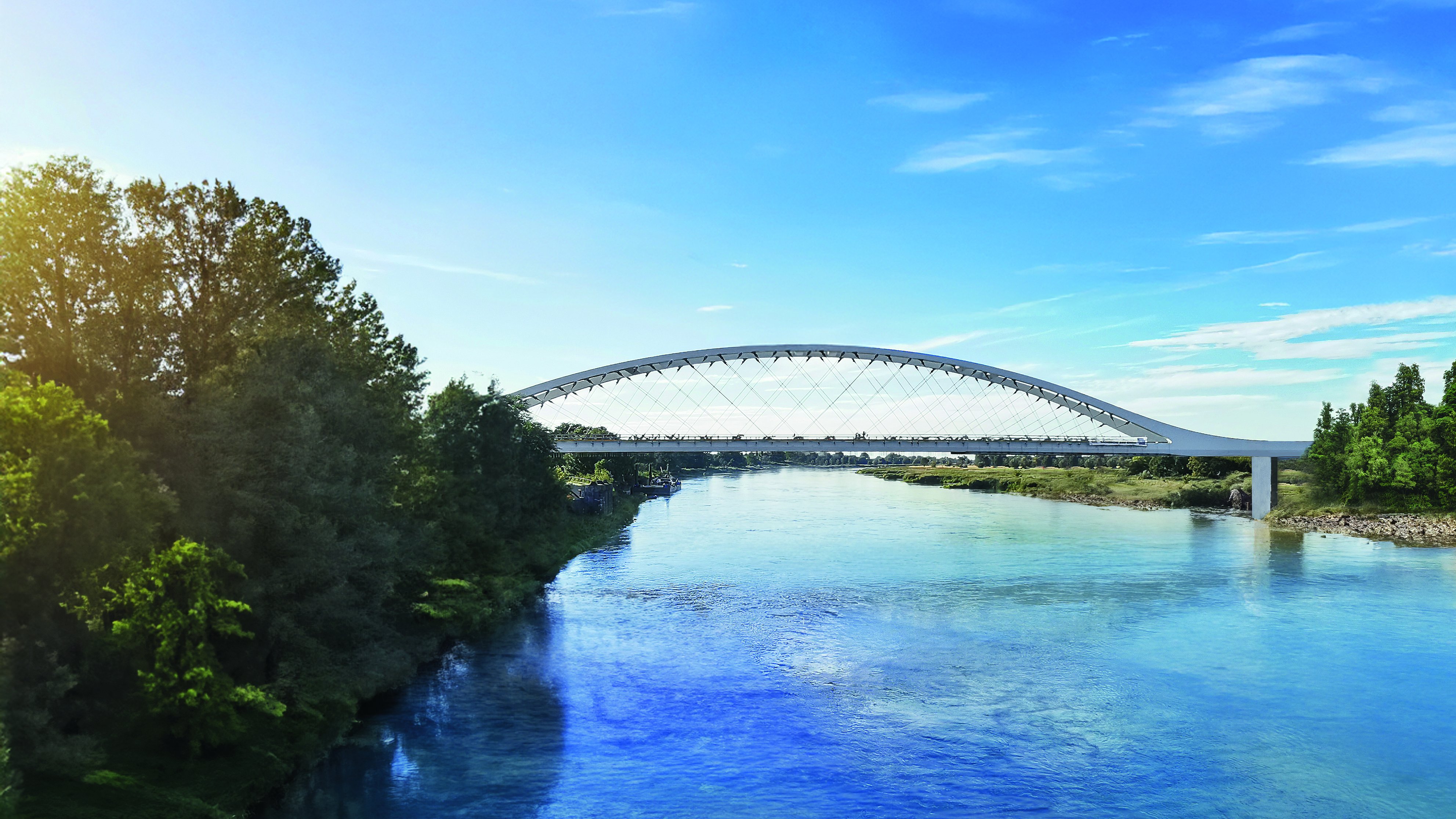
Beyond carbon-reinforced concrete, carbon fiber can also be used in other structural components, such as lightweight bridge hangers. These applications are based on the same core material advantages, including low weight, high load-bearing capacity and resistance corrosion. A prominent example of carbon fiber technology in bridge construction is the Oder Bridge in Küstrin-Kietz. The approximately 130-meter network arch bridge uses 88 lightweight carbon fiber hangers. Their low weight and high load-bearing capacity enabled a more material-efficient structural design. According to the project data, around 500 metric tons of steel and 1,600 metric tons of concrete were saved, avoiding approximately 2,500 metric tons of CO2 emissions. This example shows that the greatest benefits may arise at system level. Reducing the weight of individual structural components can influence the dimensions, material requirements, logistics and environmental impact of the entire bridge.
At the same time, the sustainability of carbon-reinforced concrete must be evaluated individually for each project. Relevant factors include structural requirements, exposure conditions, applicable approvals and lifecycle economics.
At Teijin Carbon, civil engineering is a key field in which we combine advanced carbon fiber materials with technical expertise and close collaboration across the construction value chain. We help advance durable and resource-efficient solutions for new construction and structural rehabilitation by closely working with engineers, research institutions, system providers, and infrastructure stakeholders. This commitment was also reflected in our „Mission Infrastructure“ symposium, where experts discussed the application potential of carbon concrete, as well as topics such as structural safety and real-time monitoring. Together, these perspectives help move innovative material solutions from technical development into practical infrastructure applications.