
Expanding Industrial Design Space in Thermoplastic Composites
03. November 2026 | Blog
In advanced composite manufacturing, there rarely is a single process that fits every application. Manufacturers often need to balance geometric complexity with productivity and scalability. BIMAX expands the design space for complex aerospace structures by combining high drapeability with strong mechanical performance.
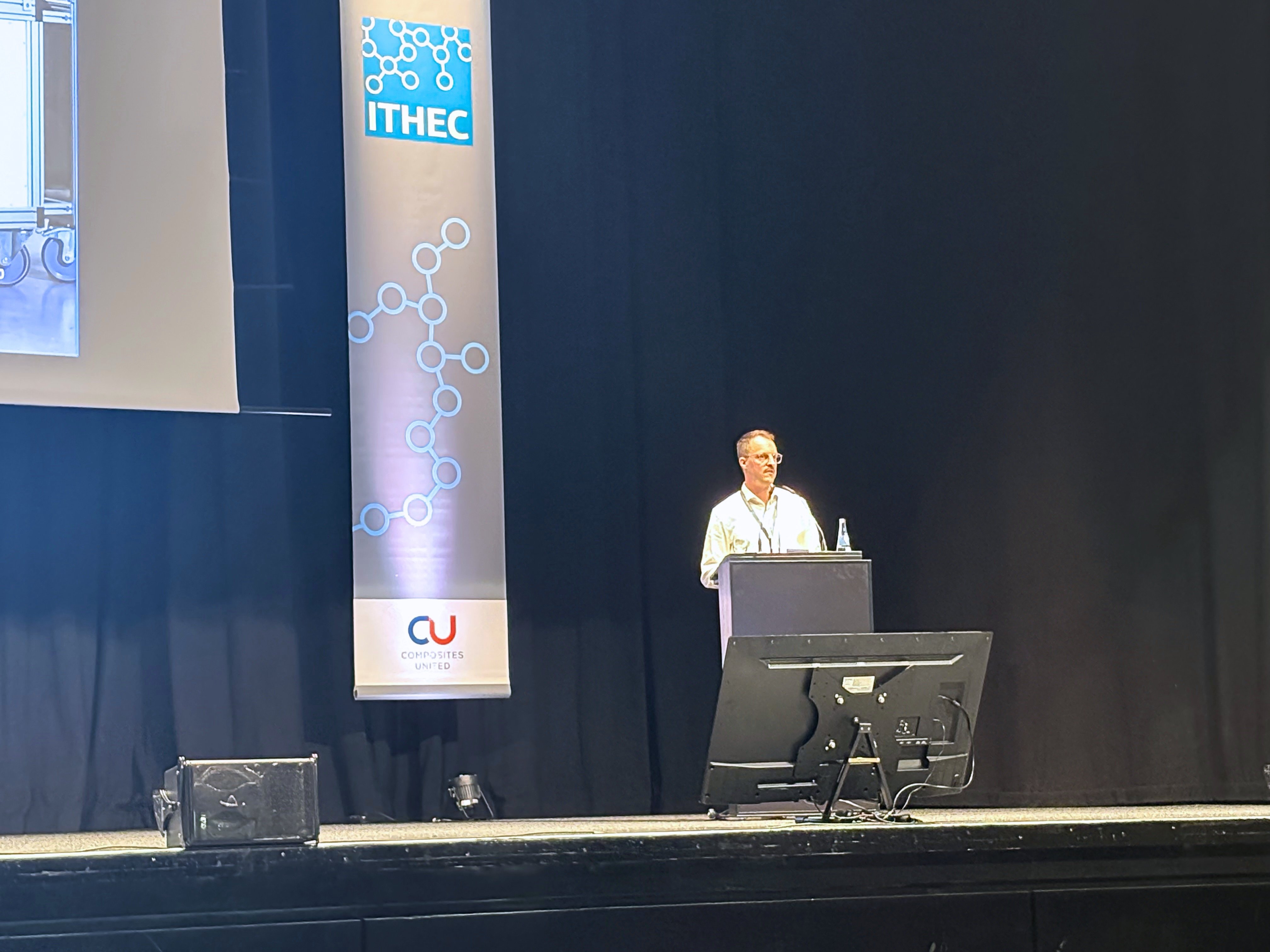
High material performance remains essential for advanced composite applications, but industrial manufacturing also requires flexibility, scalability, repeatability and efficient use of infrastructure. So how can manufacturers produce increasingly complex thermoplastic structures without being limited to a single manufacturing route? Our application engineer for thermoplastics in the aerospace market, Pascal Kube, addressed this question at the International Conference and Exhibition on Thermoplastic Composites (ITHEC). He explored how thin-ply braided carbon fiber fabrics can complement established AFP processes and expand the available manufacturing options.
Where AFP Excels and Where Braided Architectures Expand the Design Space
For large and relatively simple thermoplastic structures, AFP offers maximum productivity. It is particularly suitable when high production rates are required, geometries are comparatively simple and automated, repeatable tape placement is advantageous. As geometric complexity increases, however, AFP may require more tape steering, tighter radii, additional ply segmentation and increasingly complex machine movements. Complex shapes can also generate gaps, overlaps, tow buckling, fiber waviness or restricted end-effector access.
This is where braided fabrics come into play. They are not intended to replace AFP, but rather complement it in applications where complex geometries or infrastructure requirements make alternative manufacturing approaches attractive.
BIMAX: Handling Geometry Through Drapability Rather Than Placement
In collaboration with A&P Technology, we developed BIMAX braided tape fabric to meet the growing demand for scalable, high-speed production of composites in evolving markets such as aerospace and space. Based on thin-ply TENAXTM TPUD PAEK IMS65, the key principle is simple: BIMAX handles geometry through drapability rather than placement. This allows the material to conform naturally to complex contours, tight radii and three-dimensional geometries.
Key material characteristics include:
- - ± 45° braided fabric
- - 2x2 twill fabric style
- - 184 gsm FAW
- - 34 wt% LMPAEK™
- Up to 1,65 m width
Its drapability enables high shear deformation without wrinkling and creates opportunities for parts that AFP heads cannot place economically. BIMAX is particularly suited for medium-rate production, while also allowing manufacturers to start with manual layup at lower production volumes and gradually increase automation.
In an earlier article, we explored the “Goldilocks” zone for thermoplastic braid and Vacuum Bag Only consolidation. The key idea connecting both topics is that there is no single optimal manufacturing process for every component. Geometry, production rate, infrastructure, qualification requirements and mechanical performance all influence whether AFP, braid or a combination of both is the most suitable approach.
From VBO Consolidation to Mechanical Performance
For greater manufacturing flexibility to prove valuable, the resulting structures need to meet demanding quality and performance requirements. To evaluate this, BIMAX was consolidated using a Vacuum Bag Only process and tested in both complex geometries and mechanical comparison studies.
For the VBO demonstrator, four plies of BIMAX were arranged in a three-petal configuration and consolidated on a curved female aluminium tool with integrated resistive heaters. The butt splices were staggered between the individual layers, while a 100µm PAEK film was used as a surface layer to fill interstitial gaps and butt splices. The resulting component showed a smooth surface without pinholes or dry fibers, demonstrating that the braided architecture can be consolidated successfully even in geometrically demanding shapes.
After this insight, the next question was whether this additional manufacturing flexibility affects mechanical performance. Compared with standard UD tape configurations, the interlaced braided architecture supports load redistribution and helps constrain crack propagation. This results in higher energy absorption, enhanced damage tolerance and improved compression stability. The results presented at ITHEC showed an approximately 40 % smaller impact damage area for BIMAX compared with UD tape-based laminates, making it particularly attractive for impact-critical aerospace applications such as UAMs, UAVs and next-generation aircraft.
A second mechanical comparison with NCAMP-qualified PAEK tape systems showed comparable compression strength and enhanced damage tolerance. The compression-after-impact (CAI) strength of BIMAX exceeded the reference materials by an average of 21 %. These results indicate that material performance can be maintained while design and manufacturing flexibility are increased.
From Manufacturing Flexibility to Robust Industrial Joining
Once established that we can manufacture complex structures with BIMAX, the question shifts to whether we can also join them reliably and efficiently. This brings weldability into the equation.
In induction welding, the fiber architecture plays an important role as it influences the conductive pathways within the laminate and therefore the way heat is generated and distributed. UD laminates offer fewer fiber crossover points and can therefore be more sensitive to laminate design and fiber orientation. Braided architectures, in contrast, provide interconnected conductive pathways that can support a more uniform heating response. To evaluate this, BIMAX laminates were compared with TPUD PAEK IMS65 reference laminates using induction welding. The results showed a strong and consistent heating response, stable weld parameters and good joint quality. BIMAX also achieved up to 30 % higher Single Lap Shear Strength than the UD reference material. These results indicate that greater design and manufacturing flexibility can be achieved without compromising mechanical performance.
A Practical Path to Medium-Rate Manufacturing
All aspects considered, the results show how braided thermoplastic composites can expand the manufacturing options for complex structure. BIMAX combines high drapeability, VBO consolidation, robust mechanical performance and good weldability with comparatively low infrastructural requirements. This makes the material particularly attractive for medium-rate production where complex geometries, high damage tolerance and AFP-independent manufacturing solutions are required.
Rather than replacing established processes, braided architectures can complement them and provide a practical pathway toward broader use of thermoplastic composites in aerospace, transportation and industrial applications.
Presentation slide at ITHEC 2026 showing Pascal Kube’s talk “Expanding Industrial Design Space in Thermoplastic Composites” for Teijin Carbon.